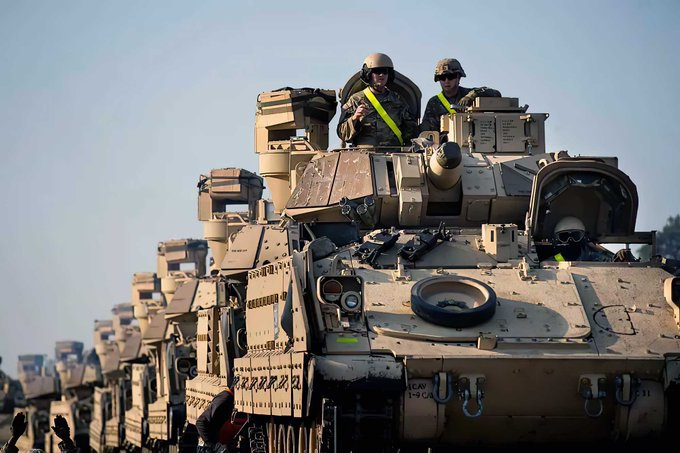
Researchers are warning that the military budgets of leaders from member countries who are gathered to mark the 75th anniversary of Nato in Washington DC, are eroding the climate, producing an estimated 233m metric tonnes of greenhouse gas, more planet-heating pollution than some entire countries.
The United Nations’ Intergovernmental Panel on Climate Change, which is the world’s top climate body, says the world must slash emissions by 43% by 2030 to meet the more ambitious goals of the Paris agreement. Reaching that target will require an annual reduction of military emissions of at least 5%, the researchers calculated.
But Nato countries are moving in the wrong direction. In 2023, the alliance made “an enduring commitment” to pour at least 2% of their national budgets into their militaries. Two-thirds of its members are expected to meet or exceed that target this year, up from just six countries in 2021.
“Our research shows that military spending increases greenhouse gas emissions, diverts critical finance from climate action, and consolidates an arms trade that fuels instability during climate breakdown,” says a new report from three international research and advocacy groups, the UK-based Transnational Institute and Tipping Point North South, and the Netherlands’ Stop Wapenhandel.
Nato member states poured $1.34tn into their militaries last year – an increase of $126bn from 2022, the authors say.
Read also: Climate expert appointed to lead UK clean energy taskforce
Military expenditure tends to be highly emitting. Aircrafts consume enormous amounts of fossil fuels, as do military bases and logistics hubs. And military equipment needs to be regularly operated and maintained to stay combat-ready – all of which produces pollution.
Overall, member states’ 2023 military budgets produced some 233m metric tonnes of greenhouse gas, the authors estimate, which is more than the total annual greenhouse gas emissions of Colombia or Qatar.
“By 2030, we have to make a radical cut in emissions,” said Nick Buxton. “But the biggest investment we’re making worldwide, and in particularly Nato, is in military spending, which isn’t just not addressing the problem, but actually worsening the problem.”
Nato includes only 16% of all countries with 32 member states. Last year, members were responsible for 55% of all global military spending, with the US accounting for more than two-thirds of that total.
Nato countries’ increased military expenditure will add an additional 31m metric tonnes of planet-warming emissions to the atmosphere – a surge of about 15%, or the greenhouse gas equivalent of adding 6.7m average US cars to the road for a year.
The US, whose military is already the top institutional emitter, was responsible for the largest share of the uptick with a budget increase of $55bn. It was followed by Poland, the UK and Germany, whose military budgets grew $16bn, $10.9bn and $10.7bn, respectively.
If just Nato’s increase in military spending were diverted to positive climate purposes, it could fully cover the minimal climate financing for developing countries proposed at this year’s United Nations climate negotiations.
The world’s armed forces produce at least 5.5% of all planet-heating pollution – more than the total footprint of Japan – according to one 2022 estimate.
Story was adapted from the Guardian.
