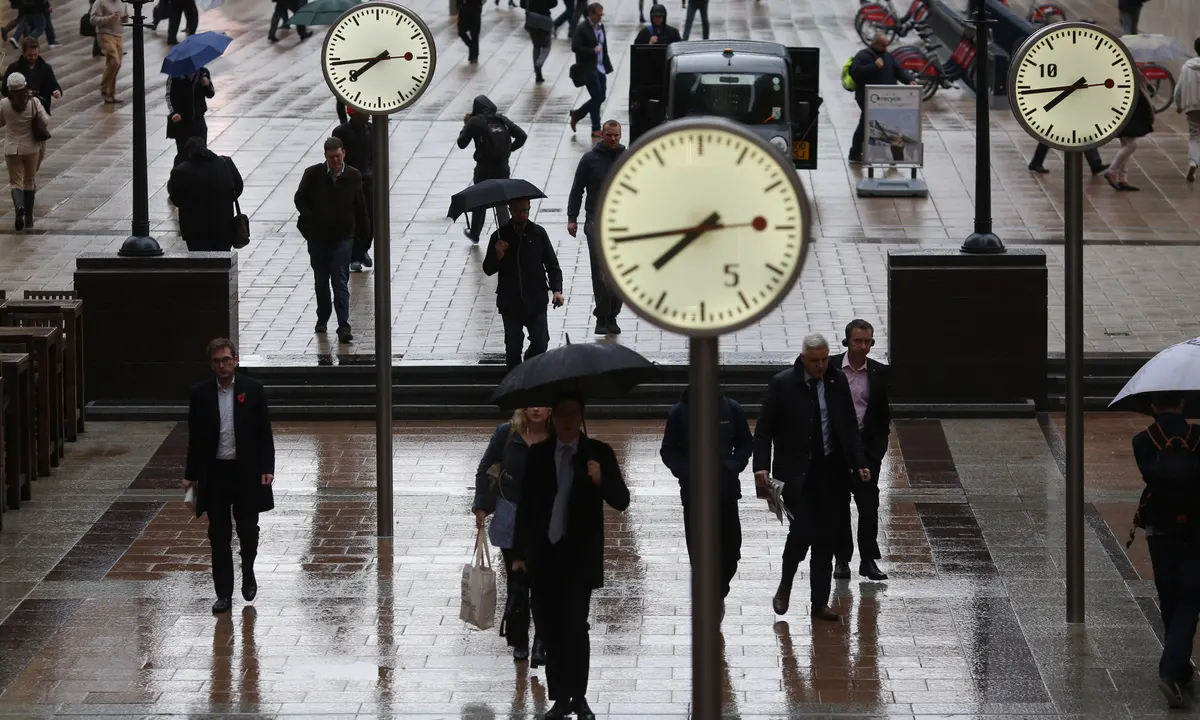
A new report has shown that the climate crisis is causing the length of each day to get longer, as the mass melting of polar ice reshapes the planet.
According to the report, the phenomenon is a striking demonstration of how humanity’s actions are transforming the Earth, scientists said, rivalling natural processes that have existed for billions of years.
The change in the length of the day is on the scale of milliseconds but this is enough to potentially disrupt internet traffic, financial transactions and GPS navigation, all of which rely on precise timekeeping.
The length of the Earth’s day has been steadily increasing over geological time due to the gravitational drag of the moon on the planet’s oceans and land. However, the melting of the Greenland and Antarctic ice sheets due to human-caused global heating has been redistributing water stored at high latitudes into the world’s oceans, leading to more water in the seas nearer the equator. This makes the Earth more oblate – or fatter – slowing the rotation of the planet and lengthening the day still further.
A recent research that showed the redistribution of water had caused the Earth’s axis of rotation – the north and south poles – to move also demonstrated the planetary impact of humanity. Other work has revealed that humanity’s carbon emissions are shrinking the stratosphere.
Read also: Report recommends Londoners should be charged for paving gardens
“We can see our impact as humans on the whole Earth system, not just locally, like the rise in temperature, but really fundamentally, altering how it moves in space and rotates,” said Prof Benedikt Soja of ETH Zurich in Switzerland. “Due to our carbon emissions, we have done this in just 100 or 200 years. Whereas the governing processes previously had been going on for billions of years, and that is striking.”
Human timekeeping is based on atomic clocks, which are extremely precise. However, the exact time of a day – one rotation of the Earth – varies due to lunar tides, climate impacts and some other factors, such as the slow rebound of the Earth’s crust after the retreat of ice sheets formed in the last ice age.
These differences have to be accounted for, said Soja: “All the datacentres that run the internet, communications and financial transactions, they are based on precise timing. We also need a precise knowledge of time for navigation, and particularly for satellites and spacecraft.”
The research, published in the Proceedings of the National Academy of Sciences of the USA, used observations and computer reconstructions to assess the impact of melting ice on the length of the day. The rate of slowing varied between 0.3 and 1.0 millisecond per century (ms/cy) between 1900 and 2000. But since 2000, as melting accelerated, the rate of change also accelerated to 1.3ms/cy.
Story was adapted from the Guardian.
