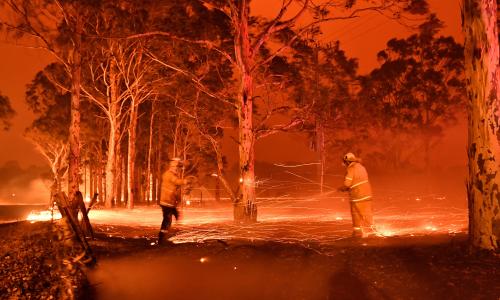
A new research has found that global heating is causing more of the planet to be burned from wildfires and probably killing an extra 12,000 people a year from breathing in smoke.
One modelling study found that global heating was particularly increasing the risk of death from wildfire smoke in Australia, South America, Europe and the boreal forests of Asia. A separate study said between 2003 and 2019 global heating had increased the area of the planet being burned almost 16% but other human actions, including clearing forests and savannahs for roads or agriculture, had lowered the total burned area by 19%.
Both studies, which were published in the journal Nature Climate Change, teased apart the effect that adding greenhouse gas emissions to the atmosphere was having on wildfires, compared with other human actions such as land clearing.
The study – led by Dr Chae Yeon Park of Japan’s National Institute for Environmental Studies – estimated that in the 2010s that almost 100,000 people died each year from breathing smoke from fires that contain tiny particles, known as PM2.5, that can penetrate the lungs and bloodstream.
How global heating is contributing to these deaths has been difficult to understand because, while hotter temperatures and lower humidity increase the risk of fires, other direct human interventions – such as the fragmenting of forests and savannahs – reduce the area that can burn or suppress the spread of fire.
To overcome the problem, the researchers looked at three models of global vegetation and fire under today’s climate conditions and compared them to a model where modern-day climate change effects were removed.
While the results varied, the authors from eight countries, including the UK, the US, Germany and China, found that in all cases global heating was causing a rising number of deaths from people breathing PM2.5 from wildfires.
In some regions temperature increases were the main factor for increasing fire risk while in others, it was lower humidity.
The authors said the health effects from wildfires could be underestimated because the “toxicity of particles originating from fire” were more severe than from other sources.
Prof Hilary Bambrick, director of the National Centre for Epidemiology and Population Health at the Australian National University, said millions of people in Australia had been exposed to dangerous and prolonged levels of pollution from smoke during the black summer fires in 2019 and 2020.
“This resulted in hundreds of deaths at the time, and will likely have long-term health consequences for many,” said Bambrick, who was not involved in the study.
“This study highlights just one of the many ways climate change is bad for our health. Understanding impacts like these will help us to better plan for the future.”
A separate study, led by scientists from the UK and Belgium, found that global heating was increasing the risk of wildfires, in particular in Australia, Siberia and African savannas.
Story was adapted from the Guardian.
