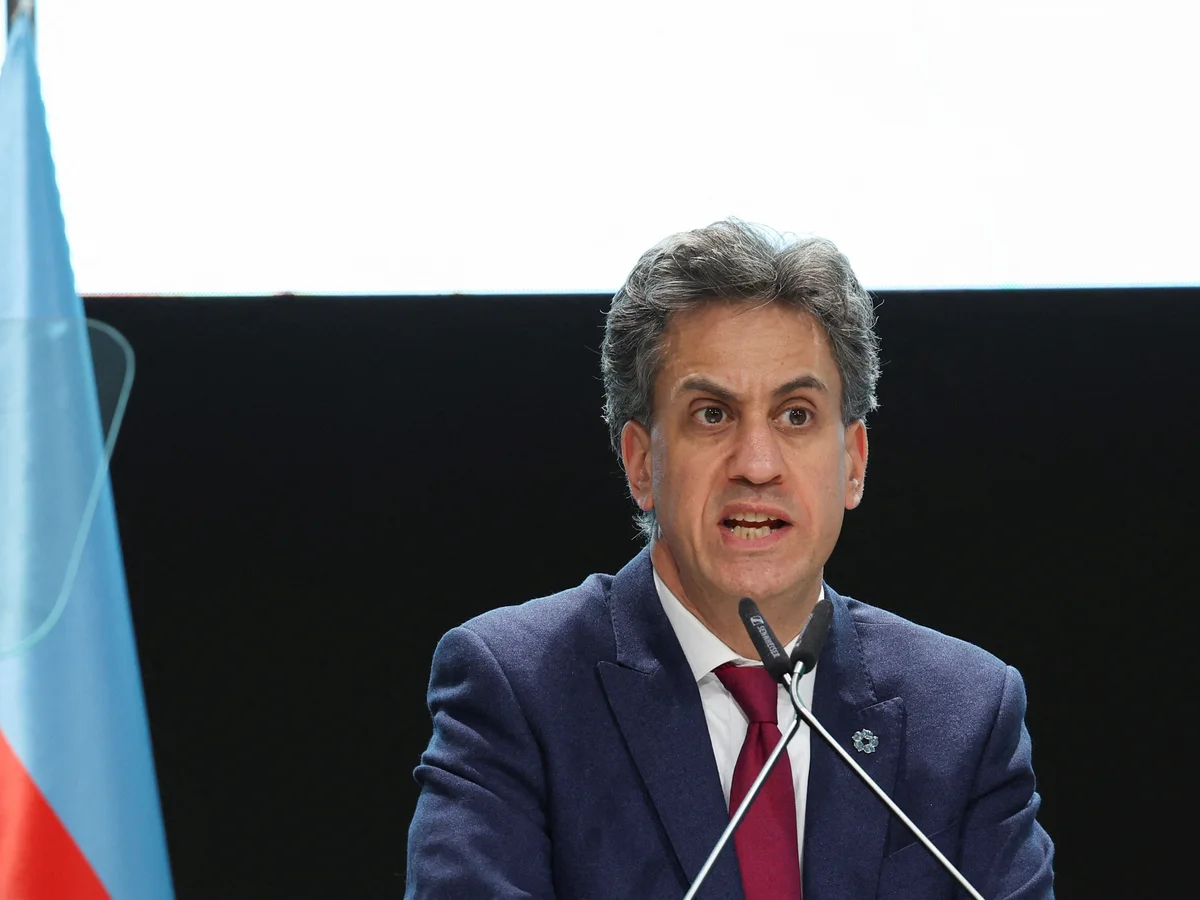
The UK energy secretary, Ed Miliband, has pledged that the country will seek a global coalition to push for climate action after a fractious end to UN climate talks in Azerbaijan.
The climate change conference (Cop29) came to an end on Sunday with a deal promising $300bn in finance for developing countries by 2035, which critics called a “failure” and “betrayal”. Miliband played a key role in the talks, attempting to bridge divisions between the rich and poor world in the hectic closing hours, late on Saturday night. He has vowed to continue working over the next year, ahead of an equally important summit in Brazil next November.
“This alliance of high ambition is the world’s centre ground of climate politics and is the best hope for the future. In our work with Brazil, hosts of Cop30, we are seeking to demonstrate this in practice,” he wrote in the Guardian.
Miliband has argued that forging a global coalition to tackle the climate crisis, and providing finance to the poor world, are in the UK’s interest.
“This idea is 100% in Britain’s self-interest,” he told journalists after Cop29. “I think there is a great British tradition of ensuring that we play our part in helping vulnerable countries who are exposed to climate change. Our estimates in the department say that [the $300bn of climate finance by 2035] could help protect up to a billion people [from] some of the effects of climate change and also on mitigation.”
Read also: Experts: China’s CO2 emissions have peaked or will in 2025
At Cop30 in Brazil, countries will expected to produce new plans for cutting greenhouse gas emissions. Miliband hailed the UK’s recent pledge of an 81% reduction in emissions compared with 1990, and vowed to work with Brazil on energy, finance and forests over the next 12 months.
Also writing in the Guardian, the president of Cop29, Mukhtar Babayev, criticised developed countries for the fractious end of Cop29, and claimed that China would have offered climate finance voluntarily if rich countries had shown more of a lead.
Babayev, Azerbaijan’s environment minister, blamed rich countries for failing to stump up enough cash for the developing world and nearly collapsing the talks by only making key concessions too late in the process.
By contrast, he said, “China spent the full two weeks coordinating their response to the negotiations in a regimented fashion with the G77 group of the world’s poorest nations. The Chinese were willing to offer more if others did so too (but the others didn’t).
“Their target of $500bn for the industrialised world’s contributions alone still would not suffice to limit global warming to 1.5C, but it was a more acceptable minimum figure – something publicly acknowledged by Kenya and several other African nations.”
China is classed as a developing country under the UN climate process, which means it carries no obligation to provide finance to poorer countries, while the rich economies do.
At Cop29, rich countries demanded that the donor base should be broadened to include emerging economies such as China and petrostates such as Saudi Arabia.
China did not object to the Cop29 deal and pointed to billions it was providing to the poor world already, mostly in the form of loans, in what is known as “south-south cooperation”. Developed countries were keen to point out that the deal struck allowed for China to contribute, while stipulating that the developed world should take the lead.
Story was adapted from the Guardian.
