
At the Kofar Mazugal abattoir in Kano, the morning air in September 2025 reeks of blood and smoke. Butchers hurry between carcasses, blades flash, and the cries of cows, goats, and camels pierce the din. For decades, this chaos drew hundreds of vultures circling and swooping on the remains.
Today, not one hovers over the slaughter slab. A mix of economic desperation, deep-rooted belief, and weak environmental enforcement is driving vultures toward extinction.

Zubairu Lawal sitting on a bench with co-workers at the Kano Abattoir Limited. (Image: Francis Annagu | Dataphyte)
“The vultures would come around here in the morning and leave in the evening,” recalls Zubairu Lawal, a 64-year-old butcher who has worked here since his youth. “In the 1990s, they were in their hundreds. We butchers never killed them. They just came to feed on the remains of the animals. Now, I have not seen one for years.”
Where hundreds of vultures once fed, only the cattle egret (belbela in Hausa), a smaller scavenger bird, now picks at scraps. “The younger generation confuses them with vultures,” Mr Lawal says, shaking his head. “Vultures are gone. What we have now are cattle egrets.”
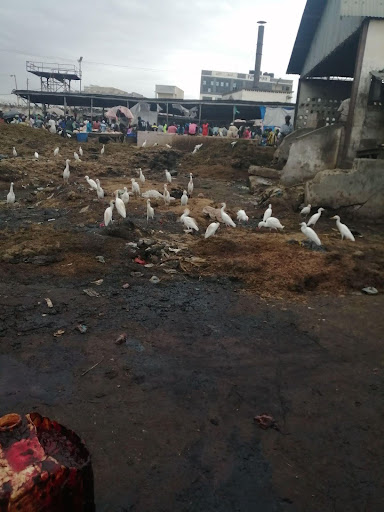
Cattle egrets feeding on congealed blood and animal remains. (Image: Francis Annagu | Dataphyte)
Once nature’s free waste managers, vultures are disappearing from Kano, northern Nigeria’s main cultural and trade centre, not from disease or habitat loss but from a growing trade in their body parts for fortune charms and traditional medicine.
In Rimi and Kurmi markets, two of Kano’s oldest trading centres known for their herbal and spiritual medicine stalls, vultures have become prized commodities. Their parts now fuel a shadow economy of hunters and healers who cater to clients seeking luck, power, or protection.
“Everything About a Vulture is Costly”
At Rimi Market, known for its clusters of herbal medicine stalls and animal part traders, healers and merchants sell powders, skins, bones, and charms used in traditional rituals. Within this bustling mix of commerce and spirituality, the vulture trade has found fertile ground and continues to thrive.
Under a roadside umbrella in Rimi Market, traditional healer Naziru Usama mixes herbs for a customer, then lowers his voice. “Everything about a vulture is costly,” he says. “The head alone costs N60,000.”
Mr Usama, who has practised traditional medicine for decades, says vultures are now scarce in Kano, found only deep in forests between Kano and Bauchi, or farther away in Taraba and Cameroon.
“We get different kinds of orders,” he explains. “Some ask for the eyes, feet, or even the things vultures pick from the ground. Someone once offered N500,000 for two vultures.”
He smiles faintly. “Just last week, someone offered N750,000 for the one I have, but I declined.”
During a visit to Mr Usama’s stall, he led Dataphyte into a dimly lit room beside his shop, where a vulture stood confined in a rough wooden cage. Mr Usama explained that the bird’s parts are used for charms and incense rituals.
“There’s a charm I make using the wings,” he said. “After burning them on coal, we use the smoke to bathe or sprinkle on a person. It brings good luck. We call it turaren wuta, a burning incense believed to carry supernatural powers.”

A caged vulture “owned” by Naziru Usama at Rimi market. (Image: Francis Annagu | Dataphyte)
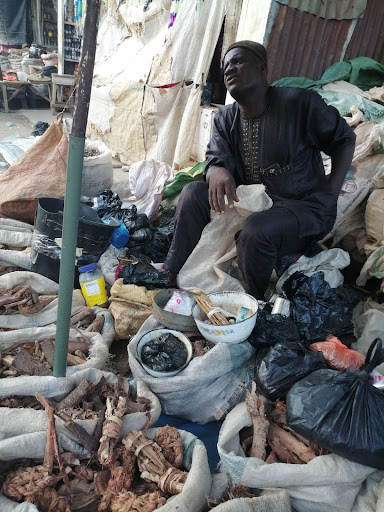
Traditional doctor, Naziru Usama, is attending to his customers. (Image: Francis Annagu | Dataphyte)
Mr Usama’s account echoes what conservationists have warned for years: that belief in the mystical potency of vultures, especially for fortune charms known locally as tsaraka, is fast driving the species toward extinction.
When Dataphyte asked if herbs could be used instead, he replied, “It depends on the strength of the charm. You can find herbs, yes, but they’re not as effective. That’s why people insist on using the bird.”
He paused, glancing at the caged vulture. “In the last ten years, everyone wants quick luck,” he said quietly, then added, “That’s why the demand has grown.”
“When We Were Growing Up…”
Abubakar Umaru Manu, a 72-year-old community elder in Gwale, recalls a different time when Dataphyte visited his home.
“When we were growing up in the 1960s and 1970s, vultures roamed our communities,” he says. “Today, they’ve been hunted down by humans. The young people, those in their thirties, don’t know them; they have never seen one unless on television.” To him, this generational disappearance is a terrible loss. “If an entire generation grows up never seeing what was formerly common,” he says, “then we have lost part of ourselves.”
His reflection captures a disturbing truth in northern Nigeria’s biodiversity crisis, the slow, unnoticed extinction of species once integral to everyday life.
Back at the abattoir, his words ring true. Nearby, a group of younger butchers laugh as they work. When Dataphyte asked if any of them had ever seen a vulture alive, not one had.
Between Beliefs, Fortune, and Extinction
At Kurmi market, Dr Garba Gaye Sulaiman, a herb seller trained in both traditional medicine and public health, tries to bridge the worlds of science and tradition.
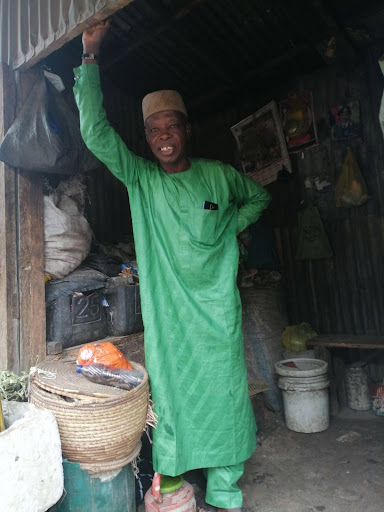
Herb seller, Dr Garba Gaye Sulaiman, standing at the door of his shop at Kurmi market. (Image source: Francis Annagu | Dataphyte)
A customer makes a purchase at Dr Sulaiman’s shop. (Photo: Francis Annagu | Dataphyte)
“We know vultures have always had a place in Hausa healing,” he explains. “People come looking for protection from poison, from business failure, from spiritual attack. They believe the bird’s strength comes from surviving on the dead without falling ill.”
His small shop smells of dried animal skins, bones, shells, and incense. Jars filled with powders and roots line the entrance. “For protection from hidden poison,” he says, “we use the head or eyes. Sometimes we dry the feathers and burn them. The patient inhales the smoke or bathes in it.”
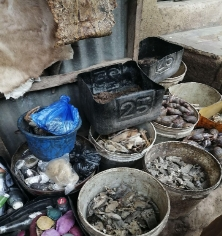
Herbs, shells, concoctions, bones, and dead animal skins at Dr Sulaiman’s shop. (Image source: Francis Annagu | Dataphyte)
But he admits to a moral struggle. “I know killing vultures is illegal. They are disappearing. I tell my colleagues to use substitutes. The power lies in the prayer and ritual, not just the animal. But still, some insist, they believe the real power is in the bird.”
He leans forward and sighs. “In the last decade, the demand for charms has surged,” he adds. “People feel helpless and seek power wherever they can find it.”
Dr Sulaiman believes education could offer hope. “We can keep our culture without destroying nature,” he says. “If we teach people that prayer and faith are what make the charm work, maybe the vultures will survive.”
But he adds wistfully, “As long as poverty and fear remain, people will keep looking for power no matter the cost.”
The Numbers Behind the Silence
In 2017 and 2018, NCF surveys found no vultures left in the wild in Kano, suggesting possible local extinction. Similarly, a 2025 Mongabay report documents how hooded vultures are vanishing from traditional urban food sources such as slaughterhouses and dumps, citing ethno-ornithological surveys in Kano and Ekiti where vultures appear to be driven out or extinct in many human-associated sites. Adding to this, local birdwatchers interviewed by Dataphyte said no vultures have been seen in the city for nearly a decade.
At the Audu Bako Zoo, the state’s main wildlife and recreational park, and one of the oldest and most popular zoos in Nigeria, birdwatchers familiar with the city’s wildlife recall their last sighting of vultures was around 2014 near Challawa industrial area, where they used to scavenge around open dumps. They noticed that by 2015 the birds were gone, now being replaced by swarms of perching birds. They link the decline to urban expansion, pollution, and growing trafficking in vulture parts.
Small populations could be seen only in protected areas such as Yankari Game Reserve in Bauchi and Gashaka Gumti National Park in Taraba, as well as tiny groups across the border in Cameroon.
Data from the National Conservation Foundation, BirdLife International, and the International Union for Conservation of Nature (IUCN) show that vulture populations in Nigeria and West Africa have declined by at least 80% in recent decades. The Hooded Vulture, once common, has recorded a 94% decline in Plateau State between 2017 and 2024. The White-backed and Rüppell’s vultures have each declined by over 90% across West Africa.
The Hooded Vulture is now classified as Critically Endangered by IUCN; its disappearance is most rapid in northern states where belief-based trade remains widespread.
Economy of Extinction
The economics are simple but devastating. A vulture head sells for N60,000. A whole bird can reach N750,000. The rarer the bird, the higher the price.
This illegal trade connects hunters, herbalists, and wealthy clients through secret networks. “The vultures used to be ignored by hunters,” says Mr Usama. “Now, even the things they pick from the ground, what we locally call ‘shekan su’, are highly priced.”
He admits that some of his buyers are businessmen or politicians seeking good fortune or protection. “They don’t want to be seen,” he says. “They send others to collect for them.”
A Law Without Teeth
At the National Environmental Standards and Regulations Enforcement Agency (NESREA) office, Head of Conservation Monitoring, Gbenga Joshua Kolawole, says the agency has no record of arrests or seizures related to vultures in the past five years.
“There is no data on any case involving vultures,” he confirms. “The species is listed under Schedule II of the Endangered Species Act and Appendix II of CITES, which means hunting or selling it without a permit is illegal. The law provides for fines or imprisonment for offenders.”
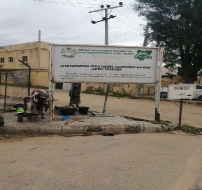
The signboard of NESREA is located at Janbulo / Kabuga Housing Estate in Gwale Local Government Area. (Image source: Francis Annagu | Dataphyte)
Yet enforcement is virtually nonexistent. When asked to make comments about challenges in monitoring markets like Rimi or Kurmi, Kolawole replies, “According to our officers in Kano, there are no challenges in carrying out our duties.”
Although the vulture trade happens openly in some markets, traders have grown more cautious in recent years. Increased awareness campaigns and occasional enforcement actions have made many dealers more discreet, preferring to transact only with trusted buyers.
NESREA says it conducts sensitisation campaigns with NGOs and traditional leaders, but none of the traders interviewed could recall any such effort. “Nobody has ever come here to teach us about vultures or wildlife,” said one herb seller at Rimi market, who spoke to Dataphyte off the record.
Vanishing Scavengers, Rising Risks
“The Hausa believe the vulture’s power lies in its immunity,” says Mr Lawal. “It feeds on dead animals but never dies. That’s why people think it can protect against poison.”
That belief endures even as the birds disappear. Without vultures, carcasses are left to rot in the open. “Now,” Mr Lawal adds, “flies are everywhere.”
Experts agree that the loss of vultures worsens waste management and public health around abattoirs. A Stanford University study shows that about 36% of scavenger populations are threatened or in decline globally.
The Director-General of the Nigerian Conservation Foundation (NCF), Dr Joseph Onoja, warned in an interview with Periscope International: “If we don’t take urgent action to preserve what remains and halt further decline, we risk driving vultures into extinction through human activities.”
This story was produced as part of Dataphyte Foundation’s Biodiversity Media Initiative project, with support from Internews’ Earth Journalism Network.
