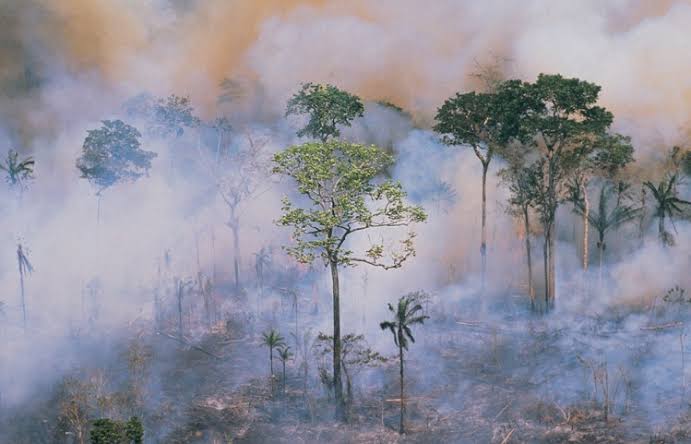
Campaigners have said that the world’s largest food companies, whose products have been linked to the widespread destruction of rainforests, have failed to come up with an adequate strategy to align their business practices with the 1.5C climate target.
The companies include the Brazilian beef firm JBS, the American agricultural firm Cargill and the Singaporean food processing firm Wilmar International.
According to reports, the leading producers of soya beans, palm oil, cocoa and cattle published their roadmap to align with 1.5C earlier this week, promising to develop and publish commodity-specific, time-bound targets on stopping deforestation which will be backed by science and checked each year.
Land use change is known to be the second biggest driver of global heating behind burning fossil fuels and the biggest cause of biodiversity loss. Halting the destruction of rainforests is a key part of tackling the climate and biodiversity crises.
And to comply with 1.5C, scientists say that all land use conversion must stop by 2030 with significant progress made by the middle of the decade. While campaigners acknowledge some progress has been made, especially with palm oil, they argue the companies have largely failed to deliver on the ambition they promised on soya and beef.
Read also: UN says Cop27 must pave way for ‘a Paris moment’ for nature
The disagreement between campaigners and companies is about the date by which firms should stop deforestation.
A senior forest campaigner at Greenpeace Brazil, Cristiane Mazzetti said that some of the companies had previously promised to rid deforestation from their supply chains by 2020 and had failed.
“We cannot afford any more greenwashing or reckless behaviour from these companies who profit from the destruction of ecosystems and come up with more delays and inadequate plans to halt and reverse the destruction they drive that will continue to fry the planet,” she was quoted as saying.
Malaysia and Indonesia, which are home to most of the world’s palm oil sectors, have recorded success at reducing deforestation in recent years, in part because of better regulation.
In her reaction, the managing director of the environmental group Madre Brava, Nico Muzi said that the plan announced at Cop27 did amount to some progress but said the commitment fell short of what was needed, especially in the meat sector.
“There are two flagrant omissions: a cutoff date to stop soy-driven deforestation now, and the exclusion of conversion by cattle and soy expansion of the largest savanna region in South America, Brazil’s Cerrado,” she said.
Also, André Vasconcelos, of Global Canopy saidthat the plan was encouraging as the companies involved represented more than 60% of Brazilian soy exports, 50% of Brazilian beef and 45% of Indonesia’s palm oil exports in 2020, although some of the main producers were missing. But he added that the companies needed to go further for the plan to be credible.
“Tackling deforestation is integral to staying under 1.5C,” he said. “Traders need to go further, faster,” he said. “The roadmap needs a proactive stance towards avoiding future deforestation and conversion, including a concrete commitment not to invest in further infrastructural development in key deforestation frontiers”.
Continuing, he said that there needs to be a commitment to a common cutoff date across commodities that includes all types of ecosystems.
Story was adapted from the Guardian.
