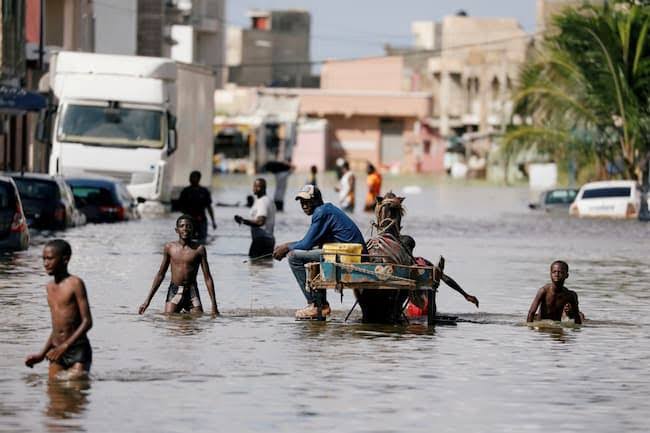
A new poll conducted by the European Investment Bank (EIB),has shown that millions of Africans, whose continent is the lowest emitter of carbon, are already feeling the harshest effects of the global climate change threat, including impacts on their daily lives, as well as their incomes and sources of living.
This is even as the globe is still far from fulfilling the objectives of the UN climate conference’s 26th edition, to limit global warming to 1.5°C by 2050.
The inaugural African edition of the EIB 2022 Climate Survey intends to contribute to a broader discussion about attitudes and expectations towards climate change.
Last month, world leaders convened in Egypt’s Sharm El Sheik for the COP 27, but it became clear that the road to 1.5°C remains unexplored, while climate change is wreaking havoc on Africa, which is increasingly regarded as the world’s whipping boy despite being the least polluter.
Read also: India plans $2 billion incentive for green hydrogen industry
The Energy Transitions Commission (ETC) cautioned in November that the globe was still a long way from fulfilling the COP 26 goals. According to the ETC research, “Degree of Urgency: Accelerating Action to Keep 1.5°C on the Table Highlights,” only national actionable commitments could keep the globe at 1.5oC.
It also noted that the just-concluded COP 27 must “serve as a catalyst to turn broad national commitments into concrete actions, and pave the way to more forceful steps to phase-out coal and halt deforestation”.
According to the EIB Africa-specific climate change study, 88 percent of African respondents believe that climate change is already influencing their daily lives. Another 61% say that climate change and environmental destruction have had an impact on their income or source of livelihood.
Furthermore, 76 percent of respondents, primarily Africans, believe renewable energy should be prioritized.
The European Investment Bank (EIB) is the European Union’s financing arm and the world’s largest multilateral lender for climate change projects. Since 2018, the European Investment Bank (EIB) has performed large-scale climate assessments in Europe, China, and the United States.
The survey’s findings come at a critical juncture for Africa, following COP 27, where the mobilization of resources for the mitigation of global warming and adaptation to its effects was central to the discussions, with a decisive agreement reached on a new “loss and damage” fund for vulnerable countries hard-hit by climatic disasters.
According to Ambroise Fayolle, vice-president of the EIB, “a large majority of respondents in the African countries polled are alerting us that climate change is already affecting their families and sources of income.”
The results of the EIB 2022 Climate Survey also show that developing renewable energy is seen as an important priority by most of the respondents.
In order to combat climate change, Africa needs to increase its spending by several hundred billion euros a year, the EIB noted.
The European multilateral lender has been supporting clean energy investments in Africa, such as wind power, hydropower and off-grid solutions, for many years. With a 55-year history of African presence, it has invested €59 billion in 52 African countries, supporting infrastructure projects, innovative firms and renewable energy schemes, in the public sector and private companies, from microenterprises to the largest multinationals.
Recognizing that Africa is the region most affected by climate change, despite contributing the least to the problem, the EIB stated that the continent faces an increased threat from extreme weather events and chronic climate change, which affect agricultural yields, food and water security, ecosystems, livelihoods, health, infrastructure, and migration. Climate change is predicted to worsen poverty, inequality, and unemployment by destroying essential resources and increasing competition for natural resources.
This story was adapted from Business a.m.
