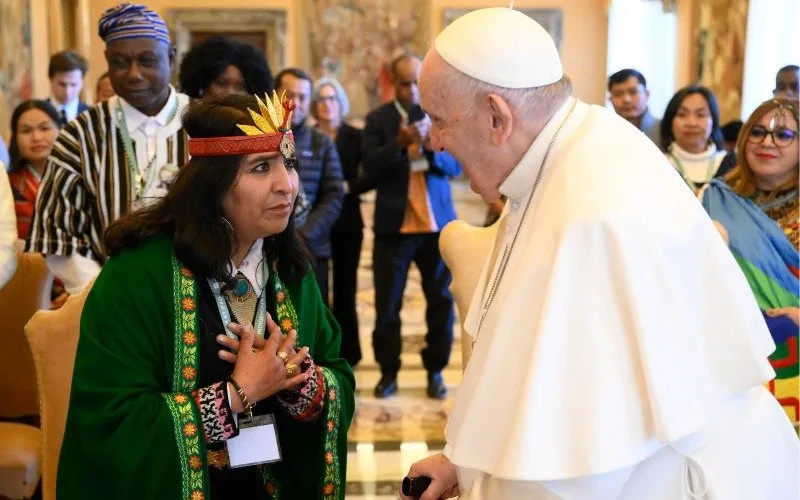
Indigenous leaders have raised concerns about the toll that extractive and exploitive industries fuelling the global economy were having on growing inequality, preventing access to basic human rights and hindering environmental sustainability during a meeting with Pope Francis on Friday.
The indigenous leaders voiced their concerns at a private audience with Pope Francis on the sidelines of the 6th Global Meeting of the Indigenous Peoples’ Forum hosted by the International Fund for Agricultural Development (IFAD), in Rome.
“The dangers facing our world have not only persisted since our last encounter in 2019 but have grown even direr in many respects,” the indigenous leaders said. “Human beings continue to destroy nature, pollute our waters, and ignite our jungles and forests,”.
Encroachments on Indigenous Peoples’ lands and territories by extractive industries as they scramble for natural resources in areas where they live, including timber-rich rainforests and mineral-rich mining areas, is a common phenomenon and the lack of effective support and protection has led to a variety of incidence of intimidation, extreme violence and even assassination.
In 2020, over one-third of the 227 climate and environmental activists murdered globally came from indigenous communities; almost three out of four murders took place in Latin America.
IFAD President Alvaro Lario who was present at the meeting harped on the role of Indigenous Peoples as climate leaders capable of protecting biodiversity and ensuring a viable future on Earth for future generations.
“No one, no agronomist or development professional will ever understand nature as deeply as the Indigenous Peoples. Nurtured over millennia, their knowledge of the Earth’s plant and animal life remains unrivalled,” Lario was quoted as saying.
Indigenous Peoples, which represent roughly 6 per cent of the world’s population, help preserve a significant portion of the world’s biodiversity extending across one-quarter of the globe’s surface but also account for 18 per cent of the world’s poorest people.
“Indigenous Peoples are displaying tremendous resilience and creativity as climate leaders and stewards of nature,” Lario said. “They are crafting practices and applying unique approaches that are invaluable in confronting the climate crisis,”.
Climate crisis continues to pose serious threats to their livelihoods as farming, pastoralism, shifting cultivation, rotational agriculture, fishing, and hunting and gathering are all dependent on a predictable climate. Indigenous Peoples are particularly vulnerable to the effects of the climate crisis due to their close relationship with the environment.
Communities continue to defend their rights, as reflected in the UN Declaration on the Rights of Indigenous Peoples, and seek spaces for effective collaboration and advocacy in national and international fora such as this week’s forum at IFAD, while they fight for a place in the global climate debate, and be part of decisions that affect them.
Meanwhile, the right to free, prior and informed consent (FPIC), including the right of Indigenous Peoples to participate in any decision-making processes that affect them, continues to be overlooked by many, due to a lack of awareness, understanding and recognition of their perspectives, actions and governance systems.
Story was adapted from Farmers Review Africa.
