A new case study report published by the International IDEA and Delibera Brasil titled “Amazonian Climate Deliberation: Insights from Three Citizen Assemblies on Climate Finance Held Ahead of COP30”, has shown that ensuring access to climate finance is key to improving climate action.
Supported by the Agence Française de Développement (AFD) and the Federal Ministry for Economic Cooperation and Development of Germany (BMZ), the report presents the findings from a project piloting climate citizen assemblies to strengthen local climate governance, specifically on access to and priorities for climate finance.
The climate assemblies were organised in the State of Pará in the Brazilian Amazon, whose capital city Belém hosted COP30 10-21 November 2025. The report contains three case studies and recommendations on how the international climate finance ecosystem can better benefit local communities and deliver global climate action.
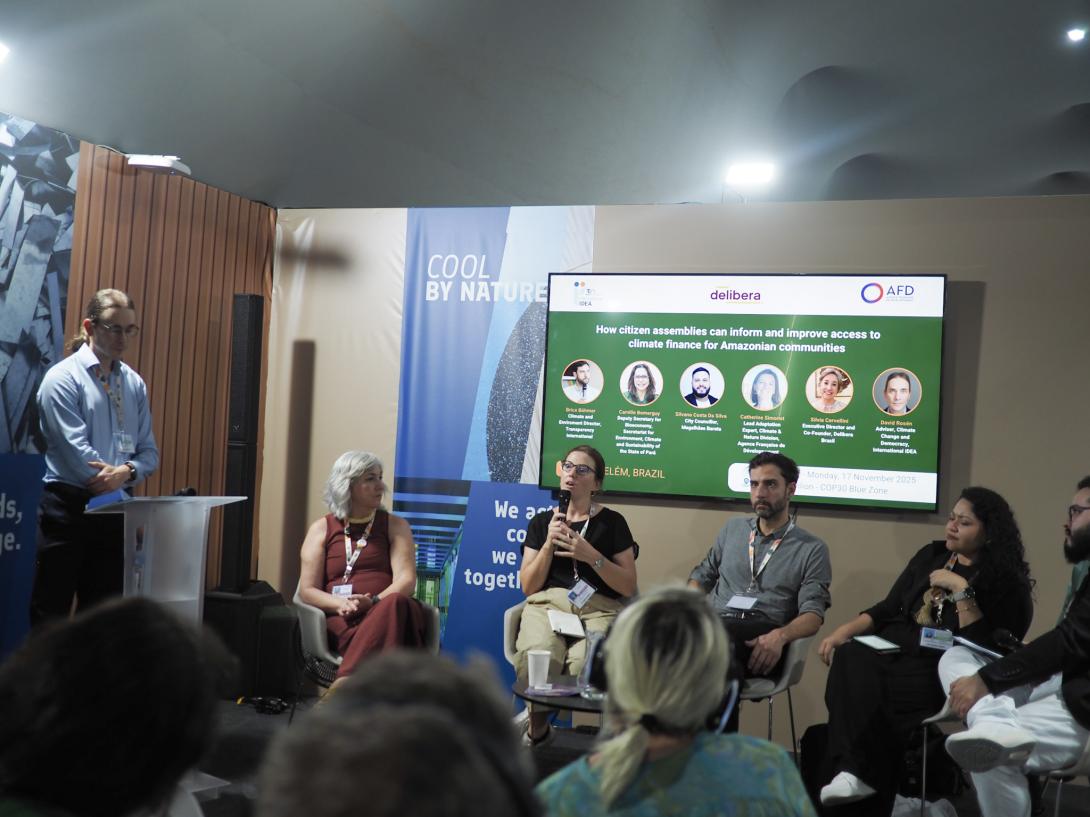
The report was launched with two dedicated events at COP30 on 17 November. The first event took place in the Finnish Pavilion. Opening the conversation, David Rosén, International IDEA Adviser on Climate Change and Democracy, introduced the initiative, which built on the 2024 International IDEA report “Deliberative Democracy and Climate Change: Exploring the Potential of Climate Assemblies in the Global South”.
Read also: 1 million evacuated as death toll from Indonesia floods hits over 700
Silvia Cervellini, Co-Founder of Delibera Brasil, presented the findings of the three climate assemblies and the global recommendations. Underscoring that citizens want and need to have a say in how climate finance is sourced and spent in their communities, while facing many challenges in accessing it, she concluded that “climate financers should think more about how they can reach municipalities, rather than municipalities thinking about how they can reach climate finance”.
One of the three communities hosting the pilot assemblies was Magalhães Barata, where Silvano Costa da Silva is City Councillor. He highlighted that while Magalhães Barata is a small community, it is very large in terms of biodiversity and faces many climate and environmental pressures. Through the climate assembly, the community had been able to develop a consensus around what issues to prioritise as well as suggestions for better management of local public resources.
Coming from a state-level perspective, Larissa Rodrigues, Cabinet Adviser to Camille Bemerguy, Deputy Secretary of Bioeconomy in the Pará State Secretariat for Environment, Climate and Sustainability, emphasized how the citizen assemblies provided a channel for dialogue between the state and local governments: Serving as an informative forum for the citizens and local communities, while providing the state government with insights they otherwise would not have access to. “Climate assemblies are like a gift to the state government of a very good diagnosis of what has to be done”, she concluded.
Building on this, Catherine Simonet, Lead Adaptation Expert in the Climate and Nature Division at Agence Francaise de Developpement (AFD), underscored the importance of bottom-up mechanisms like citizen assemblies to inform how actors like AFD can best support locally led climate adaptation. The strength of climate assemblies, she said, is two-fold: Delivering concrete outputs in the form of recommendations, while also building community resilience and common understandings through the process itself.
Brice Böhmer, Climate and Environment Director at Transparency International, claimed that climate change is now first and foremost a governance issue and responding to this requires rebalancing power and opening new doors for participation.
Story was adapted from International IDEA.
