President Asif Ali Zardari and Prime Minister Shehbaz Sharif have demanded a collective response from the nation to climate change impacts, state-run media reported, as Pakistan reels from devastating floods that have killed at least 657 since the onset of the monsoon rains in late June.
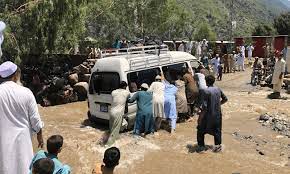
Deadly floods in the country’s northern region, especially its northwestern Khyber Pakhtunkhwa (KP) province, have killed at least 323 people and injured 156 since Aug. 15, as per the provincial disaster management authority (PDMA). Raging hill torrents flattened several homes and swept away dozens of people in KP’s Swat, Buner, Bajaur, Torghar, Mansehra, Shangla and Battagram districts last week. Officials said several bodies were found on Sunday in the worst-hit Buner district.
Pakistan’s government launched a Monsoon Tree Plantation Drive on Monday, with state broadcaster Radio Pakistan saying more than 41 million saplings will be planted across the country during the campaign.
“President Asif Ali Zardari and Prime Minister Muhammad Shehbaz Sharif have called for collective response to climate change through advancement of Green Pakistan Programme,” state broadcaster Radio Pakistan reported.
Read also: AfDB sets aside $40m to drive AGIA green infrastructure fund
In his message, Zardari said the Green Pakistan Programme is a national initiative to expand forest cover, rehabilitate degraded lands, restore the balance of nature and promote nature-based solutions.
“The President said the well-being and progress of any nation are grounded in the preservation of its forests and natural environment,” the statement added.
In his message, the prime minister called on federal and provincial governments, social and religious leaders, and citizens of all ages to renew their commitment to planting more trees.
“Tree plantation campaigns are not merely symbolic actions; they are a national duty aimed at protecting a healthy, natural environment for future generations and at preventing the destruction caused by climate change,” he added.
The prime minister said increasing Pakistan’s tree plantation rate is “critically important” to counter the harmful effects of climate change, noting that the South Asian country ranks among nations most severely affected by climate change.
“The recent abnormal monsoon rains and the resulting floods and loss of lives and property once again underscore the fact that proactive measures against climate change are essential for Pakistan,” he added.
KP Chief Minister Ali Amin Gandapur on Sunday visited Buner, where he promised survivors compensation for their financial losses, urging residents of disaster-prone areas to relocate from there.
“The data of all the losses is being compiled,” CM Gandapur told reporters in Buner. “It is beyond our power to compensate the loss of lives, but we will compensate financial losses, damages to private property.”
Several people were still missing on Sunday and search efforts were focused on areas where homes were flattened by water torrents that swept down from the mountains, carrying massive boulders that smashed into houses like explosions.
The NDMA has forecast more “heavy to very heavy rainfall” in parts of the country over the next 24 hours, particularly in Islamabad, KP, Punjab and Azad Kashmir, under the current weather system.
The monsoon season brings South Asia about three-quarters of its annual rainfall, vital for agriculture and food security, but also brings destruction.
Story was adapted from Arab News.
