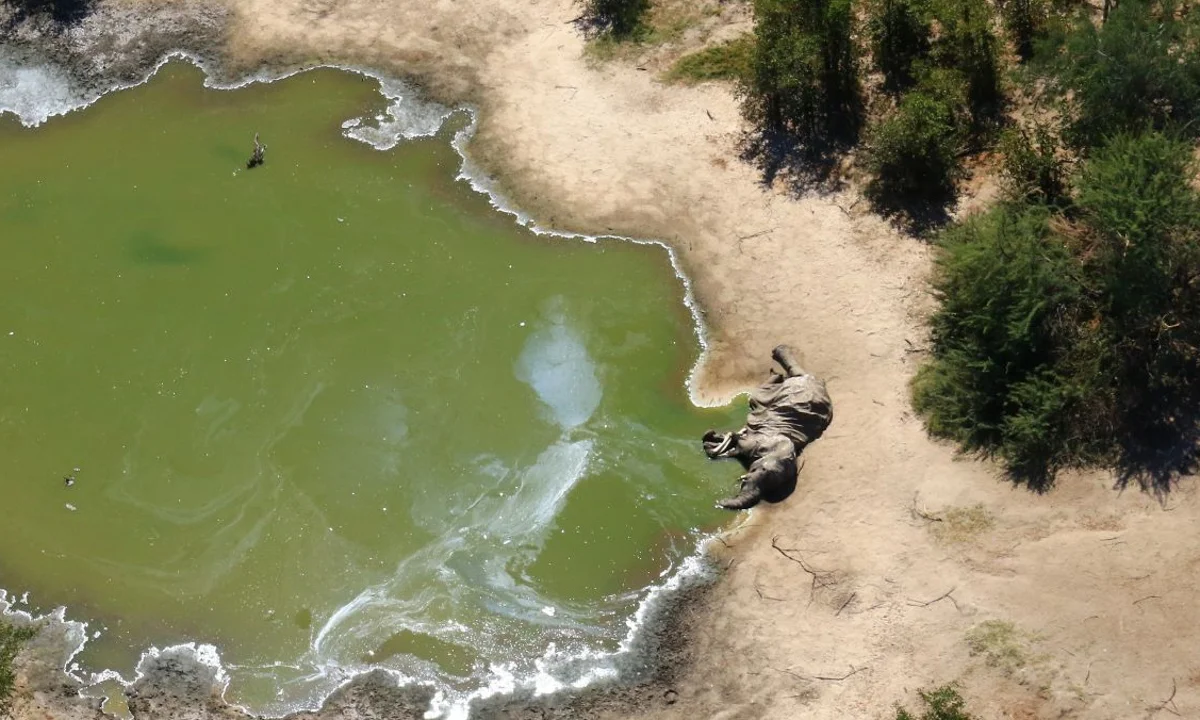
A new paper that warns of an “alarming trend” in climate-induced poisoning has shown that more than 350 elephants that died in mysterious circumstances probably drank toxic water.
The deaths in Botswana’s Okavango delta were described by scientists as a “conservation disaster”. Elephants of all ages were seen walking in circles before collapsing and dying. Carcasses were first spotted in north-eastern Botswana in May and June 2020, with many theories circulating about the cause of death, including cyanide poisoning or an unknown disease.
The incident was the largest documented elephant die-off where the cause was unknown, according to the lead researcher Davide Lomeo, a geography PhD student at King’s College London. “This is why it sparked so much concern,” he said.
Now, a new paper published in the journal Science of the Total Environment suggests the elephants were poisoned by water that contained toxic blooms of blue-green algae, or cyanobacteria. The climate crisis is increasing the intensity and severity of harmful algal blooms.
Researchers used satellite data to analyse the distribution of the carcasses relative to watering holes (there was no direct testing of samples because none were available). The team believes that the elephants generally walked just over 100km (62 miles) from the waterholes and died within 88 hours of drinking.
Read also: UK increases W’Bank contribution to boost climate finance prospects
In total they examined 3,000 waterholes, and found those that experienced increased cyanobacteria blooms in 2020 had high concentrations of carcasses. “They have no choice but to drink from them,” said Lomeo. It is possible other animals died from drinking from the waterholes, but bodies may not have been spotted from aerial surveys, and smaller carcasses could have already been taken by predators.
Researchers stated: “Globally, this event underscores the alarming trend of sudden, climate-induced diseases.” In the same year 35 elephants died in neighbouring Zimbabwe from an obscure bacteria getting into the blood, which was linked to prolonged drought conditions. In 2015, 200,000 saiga antelope died from a climate-linked outbreak of blood poisoning called haemorrhagic septicaemia in Kazakhstan. Mass-mortality events are becoming more common as the world heats up, and can push species toward extinction, experts warn.
In southern Africa, 2019 was the driest year in decades, followed by an extremely wet year in 2020. These conditions led to more sediment and nutrients being suspended in the water, which led to unprecedented algal growth. As the climate changes, much of the world is projected to become drier and hotter, with intermittent heavy rain. “It is very sad that so many elephants died but also this hints at this global trend of sudden, climate-induced disease … there is compelling evidence that this could happen again to any animal,” said Lomeo.
Story was adapted from the Guardian.
