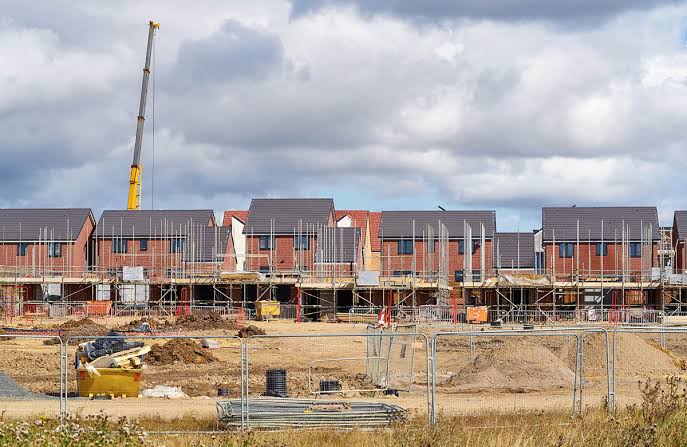
A new study has shown that England would use up the entirety of its 1.5C carbon budget on housing alone should the government stick to its pledge to build 300,000 homes a year.
A carbon budget is said to be the cumulative amount of emissions a country can emit over a specific period and England’s 1.5C budget means restricting total emissions to 2.5 of CO2 between 2022 and 2050 say the researchers, who did not look at how this compares in Scotland, Wales or Northern Ireland, but they believe it is likely to be a similar picture.
The building of new homes under a business-as-usual scenario, together with current trends on making existing homes more efficient, would mean the housing system would use up 104% of the country’s cumulative carbon budget by 2050.
Read also: Australian bank pushes for electric vehicle future
The study showed that radically retrofitting existing houses, cutting the number of second homes, stopping people from buying houses as financial investments and making people live in smaller buildings would be more sustainable ways to address the housing crisis.
In his reaction, lead researcher Dr Sophus zu Ermgassen, from the Durrell Institute of Conservation and Ecology at the University of Kent said that “In the long run, we argue that England can’t go on building new houses forever, and needs to start thinking about better and more systematic solutions as to how we are going to house everyone within our environmental limits,”.
The study, which was published in Ecological Economics, is the first to comprehensively analyse the impact of the government’s response to the housing crisis on national carbon and biodiversity goals.
Researchers who undertook the study said thatsecure housing is a fundamental human right. They however noted that potential conflicts between housing and sustainability objectives remain under-researched.
The researchers also looked at two existing models, one for evaluating the emissions needed to run UK houses, and the other, emissions from constructing new housing. The figures come from looking at decarbonising trends of housing between 1990 and 2019, meaning housing is set to be 50% more efficient by 2050.
They found that if current trends continue in England, 92% of emissions will come from existing housing, and 12% from the emissions of building and running new houses.
They also warned that policies to protect wildlife will have to be “very effective” if housing is not to undermine the government’s big biodiversity target of halting species declines by 2030.
Story was adapted from the Guardian.
