Nigeria’s President, Bola Tinubu has said that the country would require a total of $17.7 billion annually to be able to achieve its Nationally Determined Contribution (NDC) unconditional pledges by 2030.
The NDC is said to be an document embodying ambitious pledges and actions set by countries that have endorsed the Paris Agreement in order to effectively and efficiently reduce carbon emissions, thus mitigating the devastating impacts of climate change in their respective countries. It also contains actions countries intend to take in order to build resilience to adapt to the impacts of the rising temperatures.
It will be recalled that In July 2021, Nigeria submitted an updated NDC document to the United Nations Framework Convention on Climate Change (UNFCCC). In the document, Nigeria affirmed its pledges to follow the path of low carbon development by 2030 as enshrined in the Paris Accord endorsed in 2015.
Report by Climate Action Tracker, an independent global scientific analysis organisation tracking climate action since 2009, shows that Nigeria’s unconditional target meets its fair share contribution to limit warming to 1.5°C; however, its conditional target is consistent with 2°C of warming when compared to the level of climate action needed within the country.
“While Nigeria’s policies and action are 1.5°C compatible when compared to its fair share contribution, they are not on track when compared to the level of climate action needed within the country to meet that warming limit. Nigeria needs additional support to implement additional policies and to strengthen and meet its conditional target,” the report showed.
Read also: Report shows climate change displaced 427,000 children in Nigeria in 2022
The submitted NDC document shows that Nigeria has proposed stronger and ambitious targets than it last did in 2015 sequel to the endorsement of the Paris agreement.
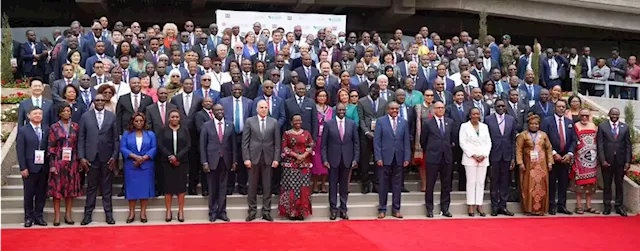
In his address at the the ongoing Africa Climate Summit in Kenya on Tuesday, the country’s minister of State, Environment and Ecological Management, Iziak Salako, said that the unconditional target in the country’s Nationally Determined Contributions (NDCs) requires $17.7 billion in investments annually,”.
The minister, who represented Mr Tinubu, said that while climate financing in Africa has been a pivotal part of the conversation at the ongoing summit so far, with world leaders and organisations raising funds via pledges, between 2019 and 2020, all of Sub- Saharan Africa received barely $20 billion dollars in climate finance.
“Annual climate finance flows to Africa are currently just 11% of what we actually require so more investments definitely have to come to the continent,” he said.
The president said that the African Climate Summit occurs at a pivotal juncture, offering Nigeria an exclusive stage to spotlight its priorities, solutions and needs regarding climate action to the global community.
“As a continent, it is critical that climate action spurs socioeconomic development for us. We know that with robust planning and increased investments in the region, this is achievable,” the president said.
Back in Nigeria, the president said that his government has articulated unchanging position to advance climate action without jeopardising economic development, noting that the country has designed an ambitious Energy Transition Plan to achieve universal access to energy by 2030 and net-zero emissions by 2060 while prioritising industrialization, job creation and economic growth.
“Significantly, our plan helps to crystallise the scale of resources needed to deliver climate targets, and it is clear that current financial flows will not suffice. Nigeria’s Energy Transition Plan requires $1.9 trillion spending up to 2060, including $410 billion above business-as-usual spending,” he said.
Story was adapted from Premium Times.
