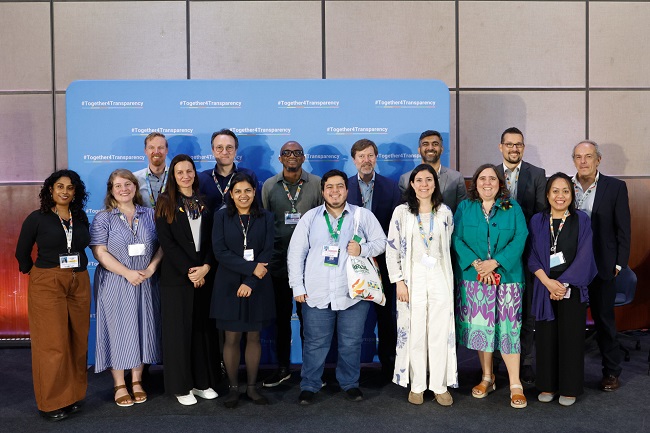
The United Nations Climate Change has unveiled the NAZCA Portal Redevelopment and Engagement Roadmap, as part of efforts to develop a modern, data-driven platform that strengthens the role of the UNFCCC secretariat as the custodian and central repository of credible climate action data from non-party stakeholders (NPS).
According to reports, the NAZCA portal, which was redeveloped to COP30 in Belém, is expected to consolidate NPS information related to mitigation, adaptation and resilience, and means of implementation.
The NAZCA portal, which was launched at COP20 in Lima, Peru, and named after the country’s iconic Nazca lines, was created to showcase climate action commitments from non-Party stakeholders and Cooperative Climate Initiatives. At COP21 in Paris, Parties formally recognised the portal, acknowledging its critical role in enhancing transparency, tracking progress, and recognising leadership across states, regions, cities, businesses, and civil society.
Since then, the portal has been expanded to include commitments, inventories, climate plans, and concrete actions, while also showcasing progress towards disclosed targets. Today, it stands at the threshold for its next phase: a strengthened, modernised user-experience, synced with the new UNFCCC Climate Data Hub, and designed to elevate transparency, ambition, and implementation of the Paris Agreement.
The roadmap presented at COP30 outlines the purpose of the redevelopment: to inform stakeholders, invite feedback, and advance a near-term vision that positions the NAZCA portal as the authoritative transparency hub for non-Party climate action. While several redevelopment elements are already underway, others remain in an exploratory phase.
At the COP30 event, UN Climate Change Transparency Manager, Vlad Trusca, highlighted that the portal’s modernised digital architecture within the UNFCCC secretariat will update its technological foundations, improve user experience, expand data accessibility, and introduce new stakeholder engagement tools – reflecting a holistic and inclusive vision for non-Party stakeholder climate action.
The roadmap also illustrates the evolution of the NAZCA portal into a comprehensive ecosystem. Planned enhancements include improved digital tools, regional engagement mechanisms, and powerful new features such as full data downloads, geospatial mapping, and domain-specific AI-driven insights.
In a keynote address at COP30, Manuel Pulgar-Vidal, COP21 President and former Minister of the Environment of Peru, reflected on the evolution of climate transparency – from National Communications to Nationally Determined Contributions, and now Biennial Transparency Reports – highlighting how these tools have shaped trust and awareness, particularly in the Global South.
He noted that climate governance has increasingly shifted from negotiation-driven processes towards pathways of economic transformation, with transparency mechanisms serving as crucial enablers in that transition.
Recalling its origins, Pulgar-Vidal emphasised that the NAZCA portal was created to integrate non-state actors into the formal climate space, providing visibility and legitimacy to their climate contributions. Today, he stressed, the NAZCA portal continues to embody the “spirit of Paris,” countering narratives of weaking ambition and reaffirming the importance of voluntary action within the global climate ecosystem.
Story was adapted from environews.
