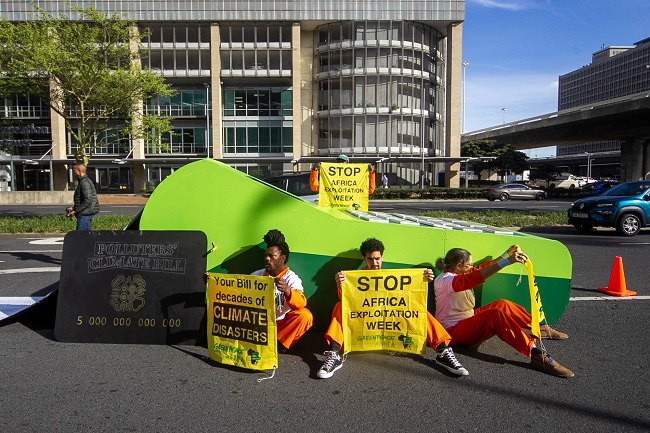
Climate activists chained themselves to a giant green payment machine outside the Cape Town International Convention Centre on Tuesday, September 30, demanding that oil and gas executives pay trillions in climate damages at what they’re denouncing as “Africa Exploitation Week.
Many of them were seen being physically dragged across the pavement by multiple officers while shouting “Polluters Must Pay! You owe us a Climate Debt!” as delegates from TotalEnergies, BP, Chevron and other fossil fuel giants entered Africa Energy Week, the continent’s largest oil and gas gathering.
The dramatic scenes unfolded as activists attempted to blockade the entrances to the venue, as the pay machine unfurled a long bill featuring the cost of climate disasters worldwide since the Paris Agreement, amounting to $ 5 trillion. However, police quickly moved to remove protesters who were chained to the massive payment machine, which they also carried off the entrance.
As officers dragged activists away, one protester could be heard bellowing “Polluters Must Pay! You owe us a Climate Debt!” while conference delegates in business suits walked past into the venue.
“While police shield polluters at the expense of the people, African communities continue paying the ultimate price for fossil fuel extraction with their lives and livelihoods,” said Sherelee Odayar, Oil and Gas Campaigner at Greenpeace Africa, as she watched fellow activists being removed. “This giant bill represents the true cost of fossil fuel extraction that oil executives have been dodging for decades, and today’s heavy-handed response shows exactly whose interests are being protected.”
Read also: Borno govt, NGOs demand funding on climate change mitigation
The payment machine featured a screen displaying clips from Greenpeace Africa’s documentary “Surviving The Aftermath, Who Pays?”, connecting extreme weather events like last year’s deadly Durban tornado to fossil fuel-driven climate change. The action targets executives from TotalEnergies, BP, Chevron, Woodside Energy, and the African Energy Chamber as they attempt to enter the venue for what activists are calling a week-long celebration of African exploitation disguised as energy development.
The protest followed a covert overnight operation where activists infiltrated hotels housing conference delegates, slipping climate justice flyers under hundreds of doors to deliver an early wake-up call about fossil fuel accountability before executives even arrived at the venue.
“Africa Energy Week is really Africa Exploitation Week – a gathering of corporate vultures circling our continent’s resources while ignoring the renewable energy solutions Africa desperately needs and abundantly possesses,” said Cynthia Moyo, Climate and Energy Campaigner at Greenpeace Africa.
“Africa has some of the world’s greatest solar, wind, and geothermal potential, yet these corporations want to lock us into decades more of fossil fuel dependence that benefits their shareholders while poisoning our communities,” added Moyo.
The action comes as Africa faces escalating climate impacts, from devastating floods in South Africa to prolonged droughts across East Africa, while the continent contributes less than 4% of global emissions but suffers disproportionately from climate consequences.
“The extractive industry has treated Africa as its personal ATM for centuries, extracting wealth while leaving pollution, poverty, and climate chaos in its wake,” Moyo continued. “It’s time for a just transition to renewable energy that serves African people, not foreign profit margins.”
Story was adapted from environewsnigeria.
