A new study has found that even the most aggressive goals of reducing greenhouse gas emissions aren’t sufficient to avoid several major climate change tipping points, in which rising temperatures cause irreversible damages that in turn cause more global warming.
Published in the journal Science, the study found that one of the most worrisome risks of climate change remains that permafrost — a layer of frozen soil in the polar regions — will continue to thaw, releasing planet-warming gases such as carbon dioxide and methane that are currently embedded in the soil.
It found that Arctic permafrost alone contains roughly 51 times as much carbon as the entirety of 2019’s global emissions, according to NASA, and if it thaws would speed up global warming at an alarming rate.
Although the last two global climate change agreements brokered by the United Nations have set an aspirational goal of limiting global warming to 1.5 degrees Celsius (2.7 degrees Fahrenheit), the study found that the permafrost may permanently thaw even if warming stays between the current 1.1°C of warming and 1.5°C, and becomes “likely” if warming falls between 1.5°C and 2°C.
Read also: Report shows 600 million Africans at risk of severe droughts
In addition to thawing permafrost, the studies stated that other potential risks include the “collapse of the Greenland and West Antarctic ice sheets” and the “die-off of low-latitude coral reefs.”
Recall that last year, a study by the Potsdam Institute for Climate Impact Research in Germany found that 3 to 6 feet of sea level rise from partial melting of the Greenland ice sheet is already likely to occur, though at its current rate it would take centuries.
“This means that a full-scale collapse of the ice sheet could have a wide array of dramatic consequences, including the disruption of the Atlantic Meridional Overturning Circulation current, a warm band of water that flows to the northeast across the Atlantic Ocean, which would cause much colder winter temperatures in Europe,” the study said.
Furthermore, it found that Coral reefs, which are underwater structures in the ocean made from the skeletons of marine invertebrates called coral, create an ecosystem that supports robust plant and animal life, and the mass death of coral reefs would deprive marine life of their habitat, destroying ocean biodiversity.
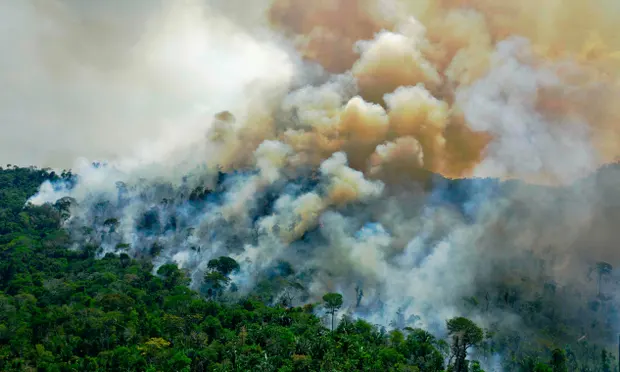
“Another emerging tipping point is the dieback of the Amazon rainforest,” the study showed. “The Amazon covers more than 2 million square miles and acts as an enormous carbon sink that helps keep temperature rise in check. Its destruction could release the equivalent of several years’ worth of global carbon emissions”.
Story was adapted from Yahoo News.
